



History is full of tales of the man behind the man: the one who pulled the strings, orchestrated the moves, and watched it all unfold from behind the scenes. Although a text at the beginning of “The Kremlin Wizard,” directed by Olivier Assayas, reminds us that the film is “a work of fiction,” it is based in part on the story of one such man: Vladislav Surkov, a Russian politician and businessman who was one of Russian President Vladimir Putin’s closest aides until he was abruptly fired in 2020.
To some, Surkov was an eminence grise in the Kremlin, but also a master of political propaganda, manipulating the media to maintain control. In the film, his alter ego is Vadim Baranov (Paul Dano), a man of calm demeanor and refined taste in art and literature. The screenplay, written by Assayas with Emmanuel Carrère, is based on the 2022 novel by Giuliano da Empoli.
The film introduces us to Baranov through an American journalist and scholar of Russia, Lawrence Rowland (Jeffrey Wright). Rowland has published an article in the journal Foreign Affairs titled “Vadim Baranov and the Invention of Fake Democracy,” which seems to have caught Baranov’s attention. During a stay in Moscow in 2019, Rowland exchanges messages on social media about the proto-Orwellian 1924 novel “We,” by the Bolshevik writer Yevgeny Zamyatin, with an unknown person. When he accepts an invitation to meet at the person’s house in the countryside, he discovers that it is Baranov himself.

A VULGAR, BUT FUNNY BUSINESSMAN
From this point on, “The Kremlin Wizard” takes the form of a story within a story. Baranov guides Rowland through his life, showing him what he got right and what he got wrong in his article. But in reality, it seems as if Baranov is returning to his own memories in search of an answer to a question that even he himself cannot fully formulate.
The story begins with his life as a student in the early 1990s, in the new Russia, immediately after the collapse of Soviet communism. Everything seemed possible and money flowed without limits. In Baranov’s memories, that period was like an endless party, or perhaps an orgy, where at a private party you could see a naked man in a chain following a punk singer. As a student and later an avant-garde theater director, he lived among art and poetry with his girlfriend, Ksenia (Alicia Vikander). When Dmitri Sidorov (Tom Sturridge), a vulgar but fun businessman and founder of the first Russian commercial bank, enters their lives, everything first becomes brighter, then darker.
Baranov later moves on to a job producing reality television shows, and it is there that the story begins to take the form we know.

“THE KREMLIN WIZARD”, FROM ENTHUSIASM TO THE OLIGARHS AND PUTIN
Essentially, “The Kremlin Wizard” is a film about how Russia went from the enthusiasm of the early post-Soviet years to the rise of the oligarchs and then to the installation of Vladimir Putin (an almost creepy Jude Law) at the head of state. The former KGB officer valued power more than money. The oligarchs who chose Putin to succeed Boris Yeltsin realized too late that he would not be their puppet.
“What interests me is the restoration of the integrity of the Russian Federation,” he tells Baranov. And that means one thing: the concentration of power in oneself.
Baranov, thanks to his talent for constructing convincing narratives, becomes useful to Putin. At this point, he has lost almost all idealism. As he becomes increasingly nihilistic, believing that the truth is whatever he decides it to be, his country also takes the same direction. His experience in theater and television proves ideal: he transforms into a genius of political communication, understanding how political theater can not only reflect reality, but create it. For this reason, people begin to call him “the New Rasputin.”
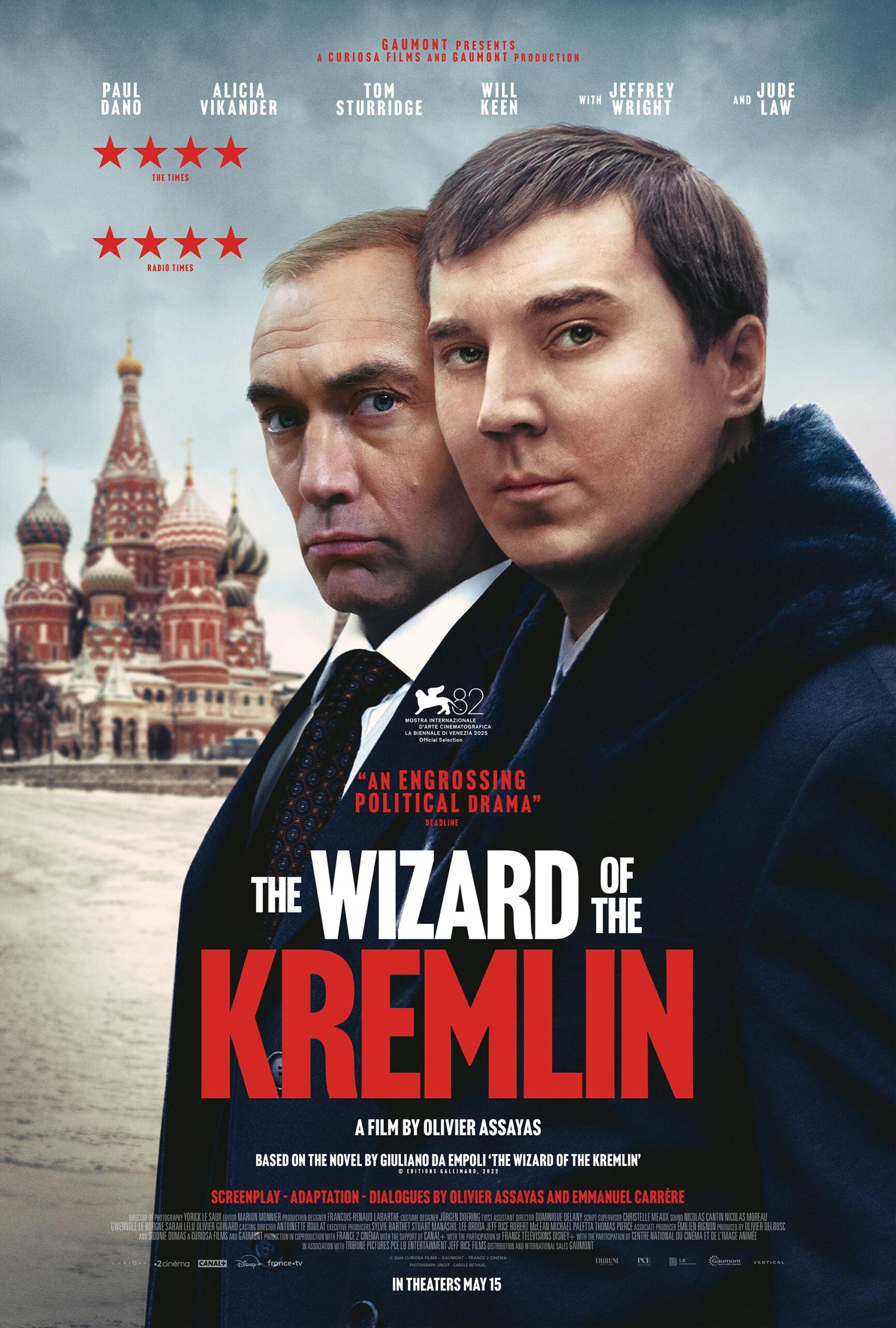
As you might have guessed from the cast, “The Kremlin Wizard” is not in Russian. The actors speak English, which suggests that the film is intended as an interpretation of Russian history for an international audience. Although it runs for 136 minutes, it covers a very wide historical period at a fast pace. This creates an interesting dramatic effect: the story flows through Baranov’s eyes in broad strokes, while figures like Putin, who we usually see every day in the news, begin to look like characters in a theatrical play. Although this approach may simplify a complex figure, it helps to understand the motives that push a person to act. In theater or cinema, characters have roles, psychological traits, and motives that lead them to their development. In this film, the partially fictionalized version of the authoritarian is not driven by the desire for money, like the oligarchs, but by the thirst for power. Building an image of strength is part of this goal; propaganda is the instrument that makes it possible.
It’s a useful way to understand leaders around the world. Baranov serves as an ideal figure for this analysis because he understands firsthand how easily people’s minds can be influenced and shaped.
This peek behind the curtain is both the greatest strength and the most terrifying element of “The Kremlin Wizard”: the idea that, in an age where truth can be artificially manufactured, those who produce it hold a large part of reality itself in their hands. But they too can be thrown away once they are no longer useful to the powerful. And then the ultimate question arises: What was all that magic for?